
WLAN
The IEEE Std 802.11bn provides enhancements for ultra high reliability (UHR) capability to a wireless local area network (WLAN). The ultra high reliability capability is defined for both an isolated Basic Service Set (BSS) and overlapping BSSs as:
at least one mode of operation capable of increasing throughput by 25%, as measured at the MAC data service Access Point, in at least one signal to interference and noise ratio (SINR) level (Rate-vs-Range), compared to the extremely high throughput MAC/PHY operation.
at least one mode of operation capable of reducing latency by 25% for the 95th percentile of the latency distribution compared to the extremely high throughput MAC/PHY operation.
at least one mode of operation capable of reducing MAC protocol data unit (MPDU) loss by 25% compared to the extremely high throughput MAC/PHY operation for a given scenario, especially for transitions between BSSs.
The IEEE Std 802.11bn provides a mechanism to reduce power consumption for access points (APs) (including mobile APs) and improved peer-to-peer (P2P) operation compared to the extremely high throughput MAC/PHY operation.
The IEEE Std 802.11bn applies to carrier frequency operation between 1 GHz and 7.250 GHz. The IEEE Std 802.11bn ensures backward compatibility and coexistence with legacy IEEE 802.11 devices in the 2.4 GHz, 5 GHz, and 6 GHz unlicensed bands.
Three UHR PPDU formats are defined:
UHR MU PPDU
UHR TB PPDU
UHR ELR PPDU
The format of the UHR MU PPDU is defined in Figure 1 (UHR MU PPDU format). This PPDU format is used for MU (Non-OFDMA and OFDMA) transmission.
The format of the UHR trigger-based PPDU is defined in Figure 2 (UHR trigger-based PPDU format). This format is used for a transmission that is a response to a Trigger frame.

The format of the UHR ELR PPDU is defined in Figure 3 (UHR ELR PPDU format). This format is used for SU transmission.

The UHR PHY provides support for a new extended long range (ELR) PPDU format, designed to overcome link budget imbalances between the uplink and downlink, and to improve spectrum efficiency for STAs operating further away from APs.
UHR ELR PPDUs have a fixed bandwidth of 20 MHz and can be used for downlink and uplink in 2.4 GHz band operationand only for the uplink in 5 GHz and 6 GHz band operations.
Feature Summary for UHR ELR PPDU:
ELR PPDU supports only 20 MHz bandwidth.
ELR PPDU supports only 2x UHR-LTF+1.6us GI.
ELR PPDU supports only two UHR-LTF symbols.
ELR PPDU supports only BPSK(MCS0) and QPSK(MCS1).
ELR PPDU supports only one spatial stream.
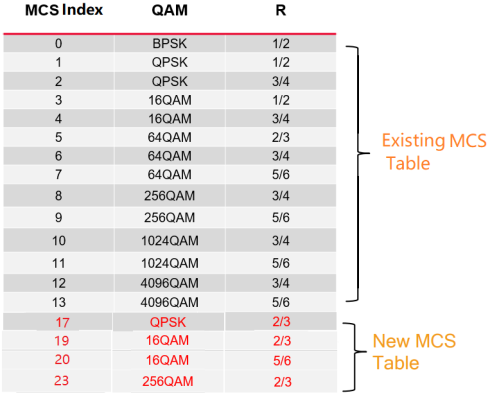
The UHR PHY continues support for modulation of data subcarriers using the EHT MCS set, which comprises BPSK, QPSK, 16-QAM, 64-QAM, 256-QAM, 1024-QAM, and 4096-QAM modulation orders and FEC coding (convolutional and LDPC) with code rates of 1/2, 2/3, 3/4, and 5/6.
Additionally, the UHR PHY defines new four MCS values for new combinations of existing modulation orders and coding rates, specifically MCS 17 for QPSK with 2/3 code rate, MCS 19 for 16-QAM with 2/3 code rate, MCS 20 for 16-QAM with 5/6 code rate, and MCS 23 for 256-QAM with 2/3 code rate.
The UHR PHY defines distributed RUs (DRU), which use a separate OFDM tone plan and distribution mapping designed to provide power and range benefits for STAs operating in frequency bands with power spectrum density limits.
Feature Summary for DRU
Supports Distributed BWs 20 MHz, 40 MHz, and 80 MHz
In a punctured 80 MHz subblock, the only allowed distributed BWs are 20 MHz and 40 MHz.
In a non-punctured 80 MHz subblock, distributed BWs 20 MHz, 40 MHz, and 80 MHz are allowed.
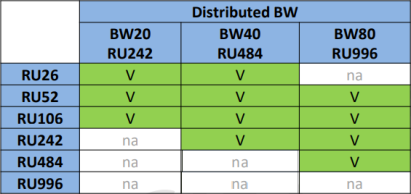
Supports the hybrid mode with dRUs and rRUs in an OFDMA transmissions
No mixing of dRU and rRU in one 80 MHz frequency subblock.
For 40 MHz PPDUs, the distributed BW is 40 MHz only.
For 20 MHz PPDUs, the distributed BW is 20 MHz only.
Hybrid mode is only for BW 160/320.
Limitations for using DRU
dRU does not support MRUs
UL MU-MIMO is not defined on dRU
dRU only uses 4x LTF
dRU only supports up to 2ss
The UHR PHY introduces support for a new longer LDPC codeword size of 2x1944 bits that may be used alongside the prior defined LDPC codeword sizes specified in the EHT PHY.
The 2x1944 LDPC subfield is defined in the trigger frame and in the User field of UHR-SIG field. The subfield indicates whether the nominal LDPC codeword length of 3888 is used in the PPDU.
For UHR ELR PPDU, the 2x1944 LDPC is not supported.
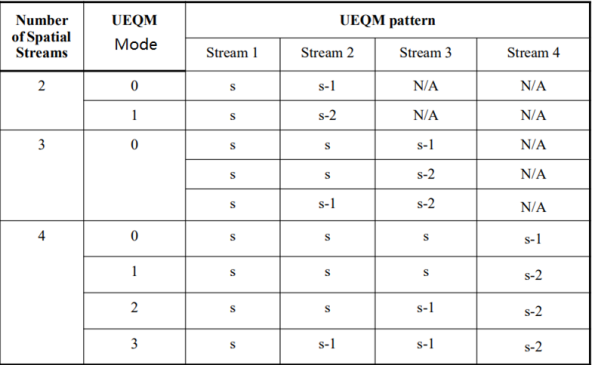
The UHR PHY provides support for Unequal Modulation, in which different spatial streams within a beamformed PPDU can use different modulation orders. This new feature can be used alongside the existing method of equal modulation transmit beamforming, as defined in the EHT PHY.
As shown in the figure below (UEQM pattern subfield encoding), UEQM is only defined for 2 ≤ Nss ≤ 4, and "s" is the constellation index value corresponding to the modulation order of the UHR-MCS used in the first spatial stream, and "s-∆" represents the modulation order(s) used in the rest of the spatial stream that is ∆ modulation levels lower than s.
The modulation order from the first to the sixth corresponds to QPSK, 16-QAM, 64-QAM, 256-QAM, 1024-QAM, and 4096-QAM.
Feature Summary for UEQM
UEQM is used only in a UHR MU PPDU with non-MU-MIMO beamformed transmission.
UEQM is used only with LDPC.
Only define unequal modulation for 2 ≤ Nss ≤ 4.
Exclude BPSK in unequal modulation over spatial streams.